Web app
In developmentIslamic Center Wadi Mubarak
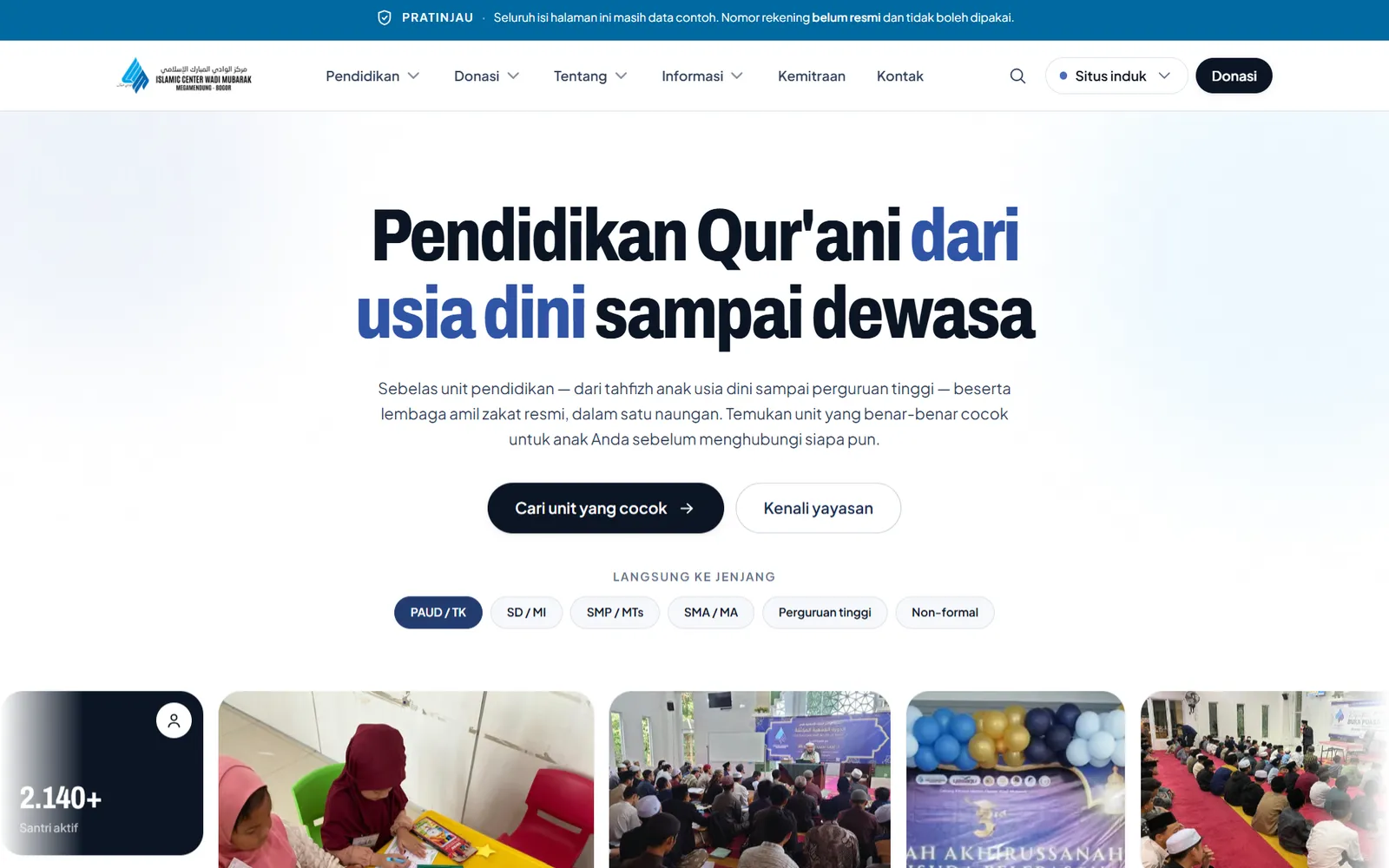
Next.js front-end on Cloudflare Workers reading from headless WordPress. 22 routes, built to a written PRD.
- Year
- 2026
- Type
- Web app
- Context
- Client project, freelance
- Client
- Islamic Center Wadi Mubarak
- Industry
- Non-profit / Islamic Education
- Role
- Solo build: architecture, front-end development, deployment
Problem
A foundation running programs, donations, and public reporting needed a site its non-technical staff could maintain. A plugin-stacked WordPress theme could not deliver the speed and transparency pages the organization wanted, and content migration would block delivery for months.
Solution
A decoupled build: Next.js App Router deployed to Cloudflare Workers via OpenNext, reading content from WordPress through WPGraphQL. Editors keep the CMS they already know; visitors get a static-fast site. The front-end was built against typed sample data so all 22 routes could ship before the CMS side existed. CMS integration is now one isolated swap.
What I built
- All 22 routes from the PRD implemented: programs, donations, transparency, impact, agenda, gallery, search, compliance pages
- Next.js App Router with strict TypeScript (tsc --noEmit) and Zod-validated content schemas
- Deployed to Cloudflare Workers with OpenNext and Wrangler
- Designed for a single-point CMS swap: sample data today, WPGraphQL tomorrow, no rewrite
- Built to a written PRD, with the PRD as the tie-breaker on any ambiguity
Engineering challenges
01
Shipping a front-end while the CMS was still a blocker
The WordPress setup (taxonomies, custom post types, ACF, WPGraphQL) was a hard dependency for every later phase. Rather than idle, I built the entire front-end against typed sample data and isolated all CMS reads behind one boundary, so the integration became a contained change instead of a rewrite. The delay stopped being a schedule risk.
02
Type safety across a CMS boundary you do not control
CMS content is untrusted input: an editor can leave a field empty or paste the wrong shape. Zod schemas validate content at the boundary, so a bad field surfaces as a handled case rather than a runtime crash in production.
03
Transparency pages for a donation-driven organization
Donation and financial-transparency pages carry a different bar than marketing pages. The information architecture has to make reporting legible and verifiable, because trust is the actual product.
Stack
- Next.js (App Router)
- TypeScript
- Zod
- Tailwind CSS
- Headless WordPress (WPGraphQL)
- Cloudflare Workers
- OpenNext
- Wrangler
Screens
